Modern Database Access: Prisma, Drizzle, and ORMs Explained
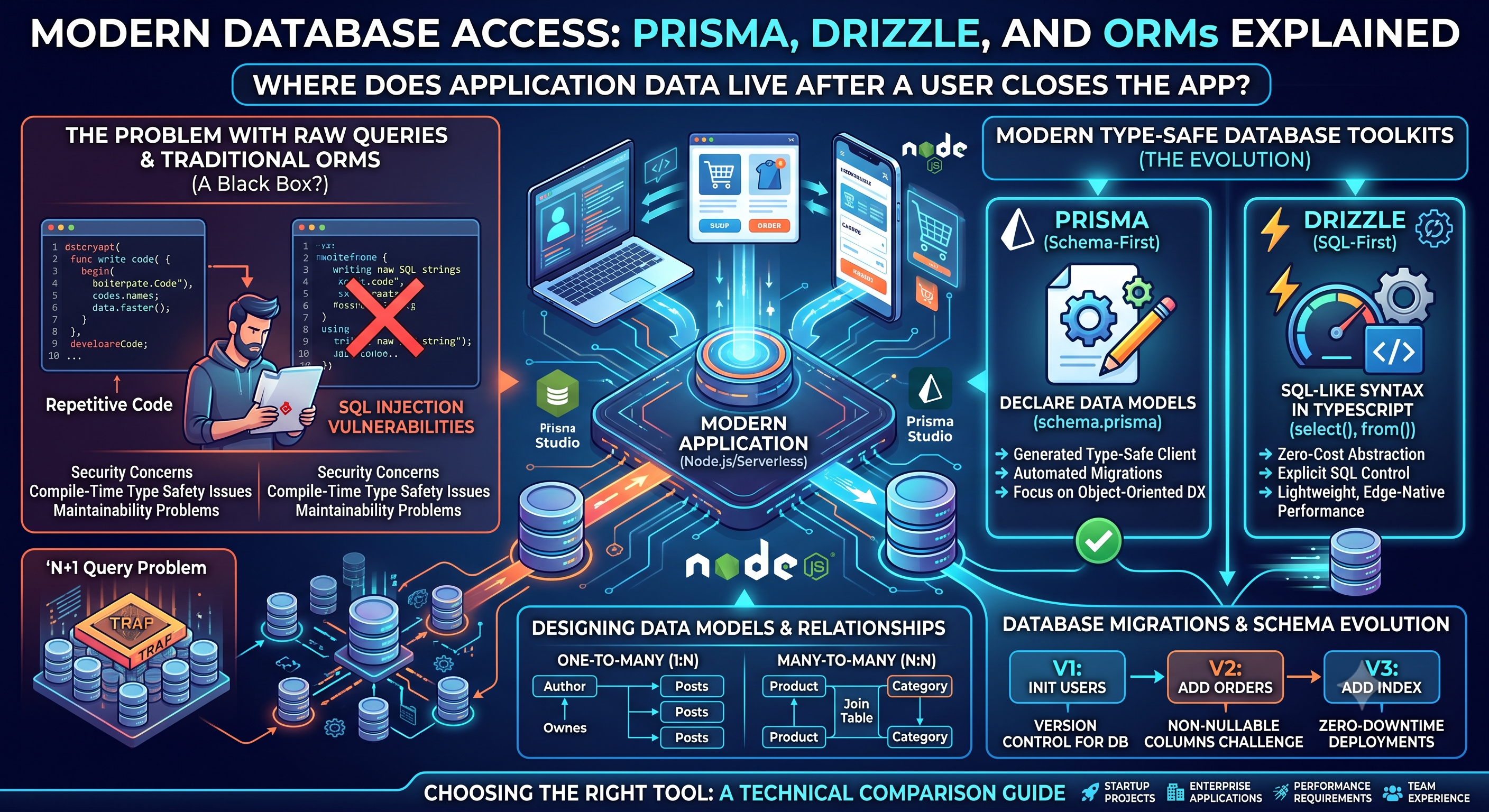
Where does application data live after a user closes the app?
When a customer places an order on an e-commerce platform, drafts a post on a blogging site, or likes a photo on social media, that data cannot simply live in application memory. The moment the server restarts, a container crashes, or a user terminates their session, volatile memory (RAM) is wiped clean.
To build reliable systems, data must be committed to a persistent storage layer: the database.
However, connecting application code (objects, functions, and types) to database storage (tables, rows, or documents) has historically been one of backend engineering’s most persistent friction points. Let's explore how modern database access has evolved—from raw queries to full Object-Relational Mappings (ORMs) and modern type-safe toolkits like Prisma and Drizzle.
1. Why Applications Need Databases
At its foundation, a database is a dedicated software system designed to store, manage, and retrieve data reliably, efficiently, and securely.
Modern backend architectures separate stateless application logic from stateful storage layers for several reasons:
Persistence: Disk and distributed storage systems guarantee data durability regardless of application lifecycle events.
Concurrency Control: Databases handle thousands of simultaneous read and write operations without corrupting state or creating race conditions.
Data Integrity & Constraints: Storage engines enforce rules—ensuring foreign keys exist, unique fields aren't duplicated, and data conforms to specific types.
Structured vs. Unstructured Data
Applications handle distinct categories of data depending on the use case:
┌────────────────────────────────────────────────────────┐
│                   APPLICATION DATA                     │
├───────────────────────────┬────────────────────────────┤
│      STRUCTURED DATA      │     UNSTRUCTURED DATA      │
│  (Relational & Strict)    │    (Flexible & Dynamic)    │
├───────────────────────────┼────────────────────────────┤
│ • Users (ID, email, pass) │ • Activity event logs      │
│ • Orders & line items     │ • User-uploaded documents  │
│ • Products & inventory    │ • Social media feeds/media │
│ • Payment transactions    │ • Real-time telemetry      │
└───────────────────────────┴────────────────────────────┘
2. SQL vs. NoSQL Databases
Before selecting a database access library, teams must choose a foundational database model.
| Feature | SQL (Relational) | NoSQL (Document / Key-Value) |
|---|---|---|
| Data Model | Tables, rows, and strict foreign-key relations | JSON-like documents, key-value pairs, graphs |
| Schema | Rigid, predefined schema | Flexible, dynamic, schema-on-read |
| Integrity | ACID compliance (Atomicity, Consistency, Isolation, Durability) | BASE model (Basically Available, Soft state, Eventual consistency) |
| Scaling | Primarily vertical (scale up); complex read-replicas | Primarily horizontal (sharding across clusters) |
| Common Examples | PostgreSQL, MySQL, SQLite | MongoDB, DynamoDB, Redis |
| Best Fit | E-commerce, banking, ERPs, structured SaaS | Real-time analytics, content catalogs, dynamic feeds |
3. The Problem with Raw Database Queries
In early web development, applications interacted with databases by writing raw SQL strings inside database drivers (such as pg for PostgreSQL or mysql2 for MySQL).
// Example: Raw SQL query execution
const userId = req.params.id;
const query = `SELECT * FROM users WHERE id = '${userId}'`;
const result = await db.query(query);
While writing raw queries offers maximum control, it introduces significant operational challenges:
Security Vulnerabilities (SQL Injection): Concatenating user inputs into raw SQL strings exposes databases to injection attacks unless developers rigorously sanitize inputs and use parameterized queries.
Boilerplate & Repetition: Mapping SQL result sets (arrays of untyped plain objects) into structured data types requires substantial repetitive boilerplate code.
Lack of Compile-Time Type Safety: If a column name changes from
first_nametofirstNamein the database, TypeScript cannot detect that your query string is broken until runtime.Maintainability & Schema Drift: Keeping database schemas, application interfaces, and query strings in sync across large engineering teams becomes error-prone.
4. What is an ORM?
An ORM (Object-Relational Mapping) is a productivity abstraction designed to bridge the conceptual gap between relational tables and object-oriented application code (often referred to as the Object-Relational Impedance Mismatch).
Relational Database Table             Application Code
┌─────────────────────────┐           ┌─────────────────────────┐
│         USERS           │   ORM     │       User Class        │
├────┬──────────┬─────────┤ ═══════>  ├─────────────────────────┤
│ id │ email    │ name    │  Maps     │ user.id                 │
│ 1  │ dev@work │ Alex    │  Rows to  │ user.email              │
│ 2  │ eng@corp │ Sam     │  Objects  │ user.name               │
└────┴──────────┴─────────┘           └─────────────────────────┘
Benefits of ORMs
Higher Developer Velocity: Standard CRUD operations (Create, Read, Update, Delete) are exposed as intuitive methods (
findMany,create,update) rather than hand-written queries.Built-in Sanitization: ORMs automatically parameterize queries, drastically reducing standard SQL injection vectors.
Automated Relationships: Fetching nested relationships (e.g., getting a user and all their associated orders) can be declared declaratively.
Tradeoffs of Using ORMs
The "Black Box" Problem: ORMs generate SQL automatically. Inefficient abstraction can result in hidden performance traps, such as the N+1 query problem (executing one initial query and $N$ subsequent queries for each related item).
Complex Query Limitations: Generating highly optimized, multi-table analytical joins with window functions using ORM syntax can be more convoluted than writing standard SQL.
Overhead: Traditional ORMs instantiate full class instances and manage dirty tracking in memory, introducing CPU and memory overhead.
5. Understanding Prisma
Prisma transformed the TypeScript ecosystem by introducing a schema-first, fully type-safe database toolkit.
                  ┌───────────────────────┐
                  │     schema.prisma     │
                  │  (Single Source of    │
                  │        Truth)         │
                  └──────────┬────────────┘
                             │
            ┌────────────────┴────────────────┐
            ▼                                 ▼
┌───────────────────────┐         ┌───────────────────────┐
│    Prisma Migrate     │         │     Prisma Client     │
│  (Generates SQL DDL)  │         │  (Generates TS Types) │
└───────────────────────┘         └───────────────────────┘
Key Pillars of Prisma
Declarative Schema (
schema.prisma): You define your data models, relations, and database configuration in a single, readable modeling language.Generated Type-Safe Client: Prisma reads your schema and generates a tailored TypeScript client (
@prisma/client). Your IDE provides instant autocompletion for tables, fields, and nested relations.Prisma Migrate: Automatically creates and runs SQL migration files based on differences detected in your
schema.prisma.Prisma Studio: A built-in visual data browser to view and edit database rows.
// Type-safe query with Prisma
const userWithPosts = await prisma.user.findUnique({
  where: { email: 'alex@example.com' },
  include: { posts: true },
});
6. Understanding Drizzle
Drizzle ORM emerged as a modern, SQL-first, lightweight alternative designed for developers who prefer the power of SQL without the abstraction layers of traditional ORMs.
┌────────────────────────────────────────────────────────┐
│                     DRIZZLE ORM                        │
├──────────────────────────┬─────────────────────────────┤
│   SQL-Like Syntax        │   Zero-Overhead / Pure TS   │
│   Uses explicit table    │   No binaries, no runtime   │
│   definitions in TS      │   engine; generates raw SQL │
└──────────────────────────┴─────────────────────────────┘
Key Pillars of Drizzle
SQL-First Philosophy: If you know SQL, you already know Drizzle. It mirrors standard SQL clauses (
select(),from(),where(),leftJoin()) directly in TypeScript.TypeScript-as-Schema: Schemas are written in pure TypeScript files using functions like
pgTable(),serial(), andtext(). There is no custom modeling language.Zero-Cost Abstraction: Drizzle does not rely on a separate query engine or Rust binary. It compiles directly to parameterized SQL strings with minimal CPU/RAM overhead.
Edge & Serverless Native: Because of its minimal bundle size and lack of native binaries, Drizzle boots instantly, making it ideal for Cloudflare Workers, AWS Lambda, and Vercel Edge functions.
// SQL-like query with Drizzle
const userWithPosts = await db
  .select()
  .from(users)
  .leftJoin(posts, eq(users.id, posts.authorId))
  .where(eq(users.email, 'alex@example.com'));
7. Prisma vs. Drizzle: Technical Comparison
| Criteria | Prisma | Drizzle ORM |
|---|---|---|
| Philosophy | Schema-first, object-oriented abstraction | SQL-first, query-builder style |
| Schema Definition | Custom DSL (schema.prisma) |
Native TypeScript (schema.ts) |
| Type Safety | Generated via code-generation step | Inferred directly from TypeScript definitions |
| Runtime Footprint | Heavier (includes query engine binary) | Ultra-lightweight (pure JS/TS) |
| Cold Starts | Noticeable in serverless/edge environments | Near-zero cold starts |
| Learning Curve | Very low (highly abstracted) | Low-to-medium (requires SQL understanding) |
| Migration Tool | prisma migrate (Fully automated) |
drizzle-kit (Generates raw SQL scripts) |
| Ecosystem Maturity | Highly mature, extensive documentation | Rapidly growing, modern community |
8. Database Migrations
Applications are never static; schemas evolve constantly. Adding a new user preference, splitting names into first_name and last_name, or adding indexing requires altering the database structure.
A database migration is version control for your database schema.
V1__init_users.sql ───► V2__add_orders_table.sql ───► V3__add_index_to_email.sql
Migration Workflow
Modify Schema: Update your data model definitions (in Prisma schema or Drizzle TS file).
Generate Migration: The CLI computes the difference (diff) between your code and the database, generating a sequential SQL migration script (e.g.,
0001_add_status.sql).Apply Migration: The migration tool executes the SQL script against the target database and records the execution in a dedicated metadata table (
_prisma_migrationsor__drizzle_migrations).
Common Migration Challenges
Non-Nullable Columns: Adding a
NOT NULLcolumn to a table with millions of existing rows will fail unless a default value or backfill strategy is provided.Zero-Downtime Deployment: Renaming or dropping columns requires a multi-step deployment strategy (Expand and Contract pattern) so older versions of running server instances do not crash during deployment.
9. Designing Data Models & Relationships
Designing scalable data models requires understanding how real-world entities relate to one another.
1. One-to-One (1:1)
A single entity relates to exactly one other entity.
Example: A
Userhas oneUserProfile.Implementation: Store a
userIdforeign key on theUserProfiletable with aUNIQUEconstraint.
2. One-to-Many (1:N)
A single entity can own or relate to multiple child entities.
Example: An
Authorwrites manyPosts.Implementation: Store an
authorIdforeign key on each row of thePoststable.
3. Many-to-Many (N:N)
Multiple entities relate to multiple entities of another type.
Example: A
Productcan belong to multipleCategories, and aCategorycontains multipleProducts.Implementation: Requires a Join Table (or Junction Table) containing foreign keys from both tables.
┌──────────────┐         ┌─────────────────────────┐         ┌────────────────┐
│   PRODUCT    │         │  PRODUCT_CATEGORIES     │         │    CATEGORY    │
├──────────────┤         ├─────────────────────────┤         ├────────────────┤
│ id: 101      │ ◄───────┤ product_id: 101 (FK)    │         │ id: 501        │
│ name: Laptop │         │ category_id: 501 (FK)   ├────────►│ name: Tech     │
└──────────────┘         └─────────────────────────┘         └────────────────┘
10. Choosing the Right Tool
Selecting between raw SQL, Prisma, and Drizzle comes down to system architecture, performance requirements, and developer workflows:
                          ┌─────────────────────────────┐
                          │ What are your requirements? │
                          └──────────────┬──────────────┘
                                         │
                 ┌───────────────────────┴───────────────────────┐
                 ▼                                               ▼
   ┌───────────────────────────┐                   ┌───────────────────────────┐
   │ Rapid Prototyping,        │                   │ Serverless / Edge,        │
   │ Monolithic Node.js App,   │                   │ Max Query Performance,    │
   │ Abstracted Object DX      │                   │ Explicit SQL Control      │
   └─────────────┬─────────────┘                   └─────────────┬─────────────┘
                 │                                               │
                 ▼                                               ▼
         Choose **Prisma**                               Choose **Drizzle**
Choose Prisma if: You want maximum developer ergonomics, a declarative unified schema, automated CRUD handling, and are deploying long-running containers (e.g., standard Node.js on ECS, Kubernetes, or VMs).
Choose Drizzle if: You are deploying to serverless/edge environments (Cloudflare Workers, Next.js API routes), demand ultra-low cold-start latency, write complex SQL queries, and want zero abstraction between your code and the database.
Choose Raw SQL / Query Builders (like Kysely) if: You are building high-throughput data processing pipelines or analytical engines requiring fine-grained control over connection pools and execution plans.
By aligning your database access strategy with your application's operational demands, you establish a stable, performant persistence layer that scales alongside your product.